Why Capital Protection Still Beats Fancy Investments
Source : https://lnkd.in/p/g6BREfNk
https://www.venturasecurities.com/news/stocks/hdfc-bank-faces-nri-complaints-over-100m-funds/
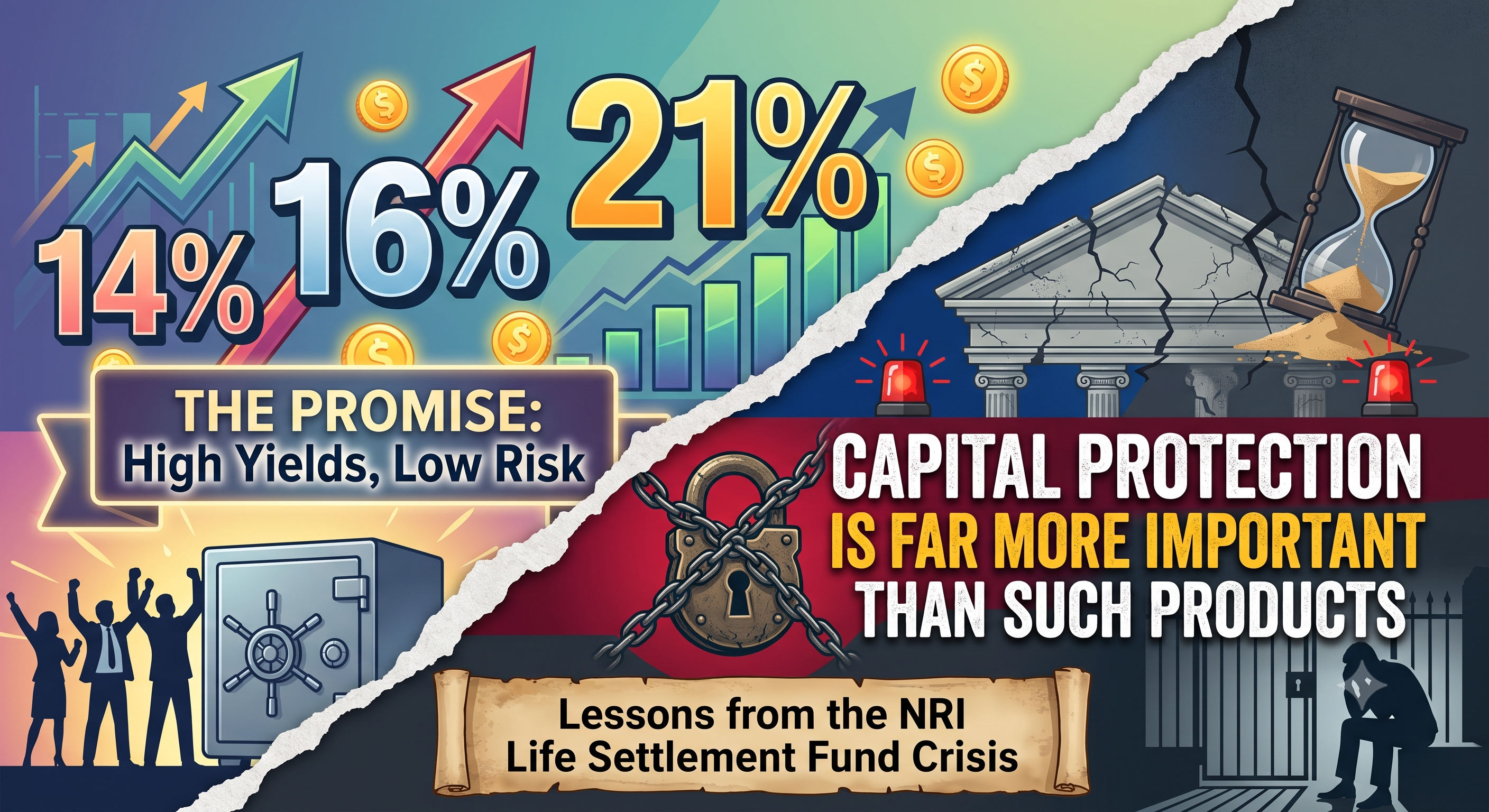
(Image source : Gemini)
Every few years, the financial world packages an tempting, complex product as the next big thing. The pitch is always lucrative: “Market-beating returns with zero stock market risk.”
For dozens of Non-Resident Indian (NRI) investors the pitch came in the form of an alternative investment marketed and highlighted return of14% to 16%, backed by historical brochures boasting numbers over 20%.
Fast-forward to today: roughly $100 million in investor funds has been stuck since redemptions froze in 2020, leaving over 70 investors knocking on regulators' doors trying to recover their hard-earned money.
The incident is a sobering reminder of an age-old investing truth: Capital protection is far more important than chasing high-yield, complex products.
What Was the Product, Really?
The investment in question was a Life Settlement Fund and the mechanics behind is
- Buying unwanted policies: In markets like the US and Europe, senior citizens who no longer want or can’t afford their life insurance policies sell them for cash on a secondary market.
- The fund steps in: The fund buys the policy at a discount—paying more than the insurer’s cash surrender value, but significantly less than the eventual payout (death benefit).
- Paying premiums & waiting: The fund takes over paying the regular insurance premiums.
- The payout: When the insured person passes away, the fund collects the full sum assured from the insurance company. The profit is the death benefit minus the purchase price, management fees, and accumulated premiums paid over the years.
Why Did Investors Buy It?
On paper, the appeal was obvious:
- No correlation with Wall Street or Dalal Street: People pass away regardless of whether the stock market crashes or central banks hike rates.
- Eye-popping returns: The marketing brochures showed average returns hovering around 17%–21%.
Where It Went Wrong
When a product seems too good to be true, the risks are usually hiding in the fine print.
Life settlement funds carry a fundamental vulnerability called longevity risk. If the insured individuals live significantly longer than actuarial tables predict, the fund must keep paying premiums year after year. Those extra costs rapidly eat into projected returns.
Worse, secondary insurance policies are inherently illiquid. You cannot simply cash out an insurance policy for a need. When market volatility hit in 2020 and multiple investors asked for their money back, the fund ground to a halt. Redemptions were suspended, and money has been locked ever since.
3 Lessons Every Investor Should Remember
1. If you don't understand the cash flow, pass
If an you are not able understand how an asset generates returns in two plain English sentences, pause. Complexity is frequently used to cover them up.
2. Beware the "Distributor vs. Guarantor" trap
Just because an investment is offered through a premier private bank does not mean the bank guarantees your principal. Wealth desks distribute third-party alternative products all the time; when things go south, the distributor relationship often ends where the fund manager's contract begins.
3. Return of capital > Return on capital
A steady, boring 6% to 8% in liquid, transparent assets will always beat a theoretical 16% where your principal can get locked indefinitely. In investing, survival is the only strategy that compounds.
| Before you reach for an tempting product to squeeze an extra 3%–4% out of your portfolio, ask yourself: Can you afford to lose 100% of the principal just to chase that yield? |
|---|